

 Places
 Guides
 Map
Map Outdoor games
 Trails
 Events
 Mobile app
 Contact
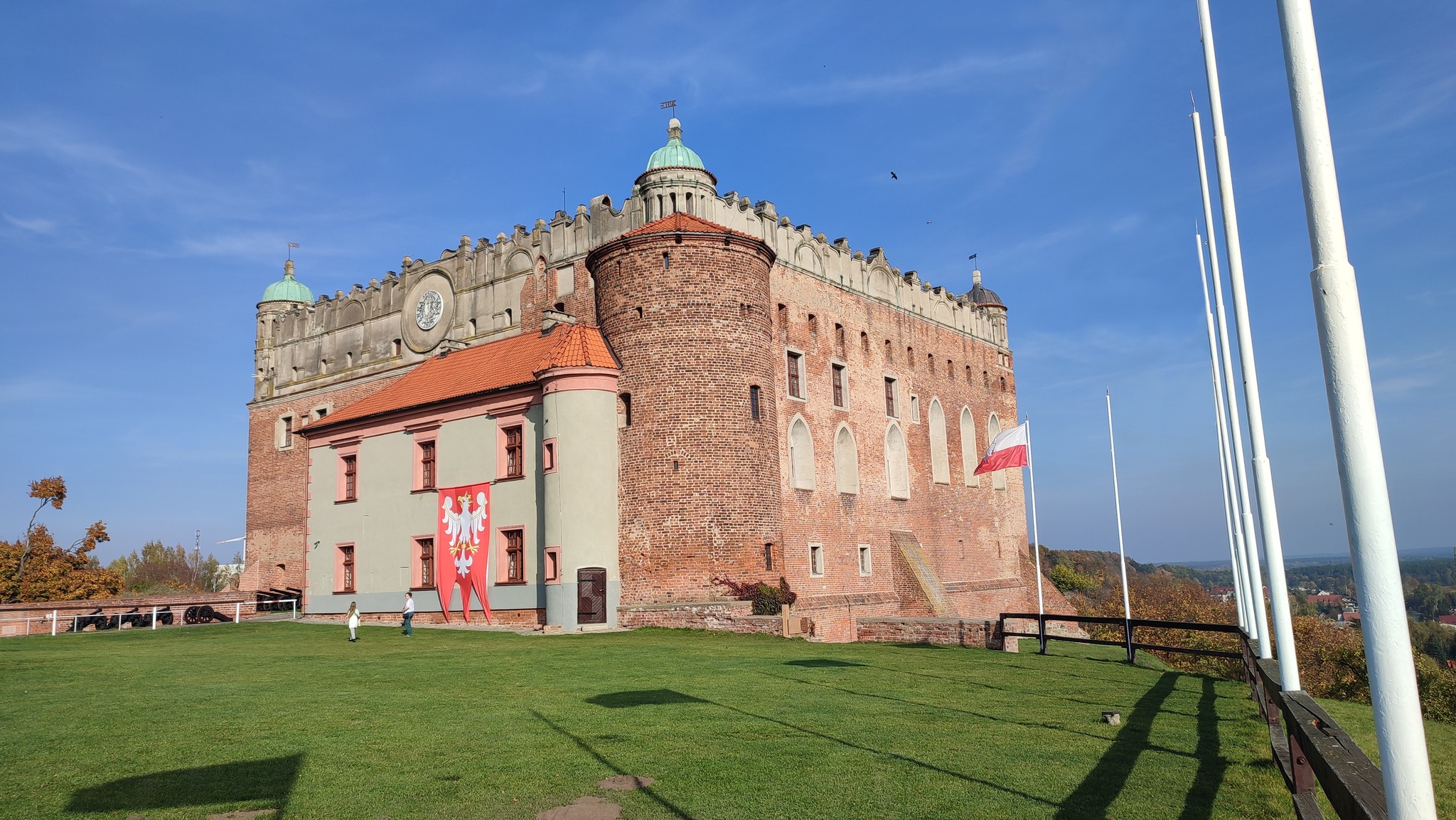
Golub Castle was built at the turn of the 13th and 14th centuries by the Order of the Hospital of the Blessed Virgin Mary of the German House in Jerusalem, known as the Order of the Teutonic Knights. It was probably commandant Konrad von Sack who initiated the construction of the castle. It is located on the territory of Chelmno Land, which was granted to the Teutonic Knights in 1228 by Duke Konrad of Mazovia. The duke was looking for the support from the Order's knights in the battles against the pagan Prussians. However, the Order decided to establish its own state here and claim these lands as its property, which consequently was the cause of the Polish-Teutonic wars.
Elements of a monastery and a fortress were combined in the castle. It was situated near the Drweca River and it was the natural border of the newly created state of the Teutonic Order. Across the river there was the Dobrzyń Land which at that time belonged to Mazovia. Therefore, the castle was supposed to have a defensive and military function as well as it was a home for the Teutonic Knights. The stronghold consisted of a main castle and a pre-castle. It also had an agricultural section with stables, barns and granaries.
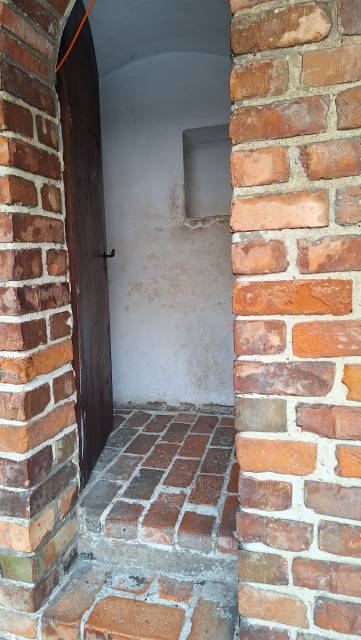
The main castle was built on a quadrangle plan around an inner courtyard. It had four wings with brick walls and a high tower in the north-east corner. Entering the castle meant passing through the bailey, which was walled and protected by a moat with a drawbridge. There was also an inner moat with another bridge. The entrance was guarded by a gate. The gatekeeper had his own chamber to the right of the entrance. A well was dug in the middle of the courtyard, which is now buried, and it could have been used in the event of a siege. According to legends, underground passages led from the castle cellars to the town or directly to the Golub Church.
The ground floor of the castle was occupied by service rooms such as kitchens, bakeries and stables. The first floor, which was the living area, contained the rooms necessary for the castle to function as a monastery. The second floor was used to store grain and weapons. If necessary, this upper floor could be accessed from the living floor through passages hidden in the castle walls.
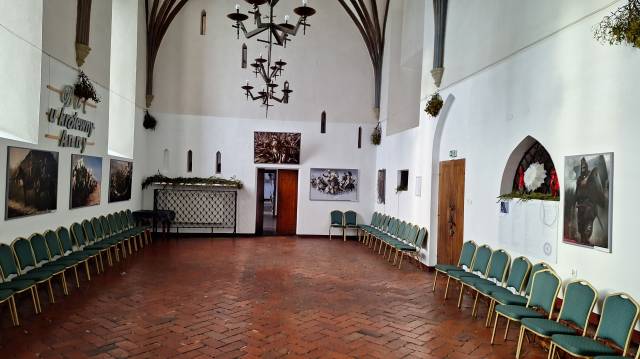
The rooms for the friars were on the first floor. The south wing housed the Chapel of the Holy Cross with a three-nave star vault. This was where the knights spent their daily prayers. Also in this wing was the chapter house with a cross-ribbed vault, which served as a meeting place. The infirmary or hospital room was located between these rooms. In addition, the sacristy was located next to the chapel in the east wing, behind which was the refectory or dining room. The north wing was used as a dormitory or knight's bedroom. This was where the ordinary knights slept; the Komtur - the knight commander who was the most important person in the castle, had a separate bedroom in the west wing.
It is worth mentioning that a dozen monastic knights usually lived in the fortress. Such a limited garrison lived here in times of peace. If there was a threat of an attack, reinforcements would be called in and the defence would be much more numerous. Polish rulers who wanted to regain the Chelmno region stormed the castle several times. The first was Władysław Łokietek, who made several unsuccessful forays into the area and attacked the castle without success. The castle was more effectively attacked by King Władysław Jagiello. During the Great War of 1409-1411, the Teutonic Order was severely weakened at the Battle of Grunwald in 1410. The Polish king managed to capture the castle in Golub. However, as a result of the First Peace Treaty of Torun in 1411, the castle was returned to the Teutonic Order.
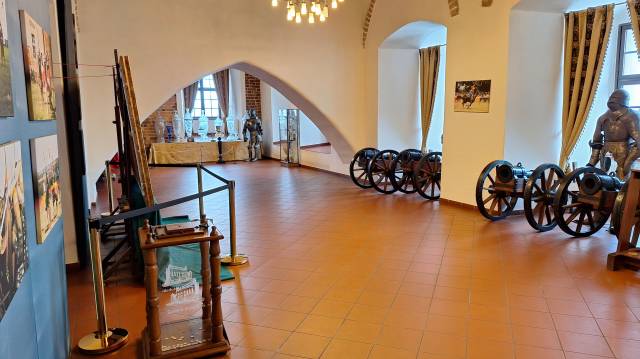
Wladysław Jagiello captured the castle again in 1422 in an event known as the Golub War. During the attack, the walls of the fortress were under fire from cannons. However, the Teutonic Knights took over the castle back again at the end of 1422, undertaking to repair the damage. It was just after the Thirteen Years' War, in the years 1454-1466, when the Chelmno Land became part of Poland. The Teutonic Order was replaced by the Polish Starosty and the castle became the starost's seat. The starost (Polish starosta ) was the collegiate executive body in the district, heading the board, elected by the county council. The castle was reconstructed, and its appearance changed.
It was decided to rebuild the castle and the initial works were commissioned by King Sigismund the Old. (Polish: Zygmunt I Stary). The former Teutonic fortress was gradually transformed into a Renaissance palace. At that time the Starosty was under administration of the Kostka family. The reconstruction was completed by Anna Vasa (Polish: Anna Wazówna) the sister of King Sigismund III Vasa (Polish: Zygmunt III Waza) who was the Starost of Golub in 1611-1625. It is believed that the castle became the summer residence of the duchess at the time. The defensive architectural elements were replaced by Renaissance decorations. The parapet was added and round towers with cupolas were built in the corners of the castle. The windows in the rooms were reduced in size and redesigned.
The exception is the chapel, where the Gothic character has been retained. In addition, the furniture was replaced, and the interiors decorated wall paintings. The façade was decorated with sgraffito ornaments. The rooms on the second floor began to be made habitable for servants and visitors. In 1623, Anna Vasa hosted King Sigismund III Vasa and his court at her residence.
To commemorate this visit, a bell was cast, which can still be found in the tower of the Golub church.
The duchess took a keen interest in botany, and it is believed that under her orders gardens were planted on the slopes of the castle hill. Anna grew plants, which may have included tobacco, probably imported from Turkey. Interestingly, the duchess sold her own jewels to be able to finance the publication of The Herbarium (In Polish: Zielnik ) of Simon Syrenius, a scholar of the Cracow Academy. In this botanical atlas, he described more than 700 herbs – with illustrations and their common usage. Anna Vasa was not the only woman to rule the Golub Starosty. Besides her, Queen Konstanze of Austria - wife of Sigismund III Vasa, her daughter Anna Katarzyna and also Cecylia Renata - wife of King Vladyslav IV – administered the castle. Later the castle was looked after by the families of Szczawiński, Lubomirski, Grudziński, as well as Denhoff and Wessel families.
The first partition of Poland took place in 1772. At that time Golub town, together with the castle, was annexed by Prussia. After the second partition in 1793, Dobrzyń town came under Prussian rule along with Golub. As a result of the turmoil caused by the Franco-Prussian War, both towns became part of the Duchy of Warsaw, and the French, after evicting the Prussian officials stationed at the castle, set up a lazarette (hospital) there. From 1815, as a result of the agreements made at the Congress of Vienna, the Drwęca again became a border river. Thus, it was separated between the two partitions: Prussian and Russian.
Golub, together with the former Teutonic stronghold, was part of the Prussian partition, while Dobrzyn, on the other side of the river, was part of the Russian partition. All this turbulence did not do any good to the castle, which began to deteriorate. The original wooden cloisters were demolished and used as firewood due to the decision of the forestry officer Richter. The ground floor of the castle was also used as pig stalls and the courtyard was used as a manure pit. There was even a prison in the castle. Moreover, Golub was hit twice by two hurricanes in 1842 and 1867 which left their marks on the former fortress. The strong winds overturned some of the Renaissance parapets, which fell inside, destroying the roofs, ceilings and vaults all the way to the cellars. Despite the poor condition, the castle continued to function as a school and teacher's residence.
It was not until the beginning of the 20th century that the castle was once again a subject of the public interest and a substantial sum of money was allocated to improve its condition. Necessary renovation works were carried out. Kaiser Wilhelm II, who was fascinated by Teutonic architecture, also found funds to repair the visible damage. In 1913, an inspection by a heritage conservator led to the idea of installing a roof.
Unfortunately, this idea was not brought to life as the First World War broke out in 1914. When the war ended in 1918, Poland revived and after the country's border turmoil, both Golub and Dobrzyń were within its borders. A regional museum was opened in the castle as early as 1920, although it is known that the buildings were in poor condition. The roof was repaired shortly before the outbreak of the Second World War. In 1939 the German authorities took over the castle and between 1941 and 1944 it was used as a training camp for Nazi youth. After the war, the castle was returned to Poland. It was gradually rebuilt and furnished.
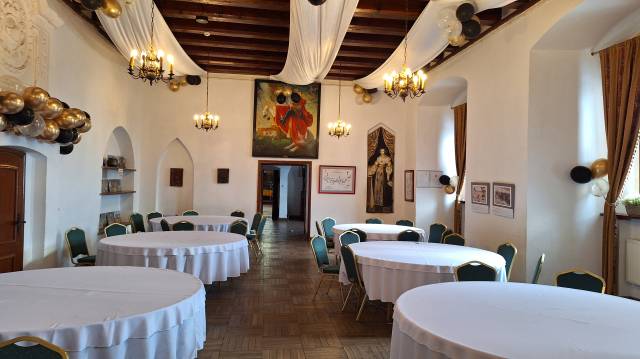
In 1964 the Golub-Dobrzyń branch of the Polish Tourist and Sightseeing Society was established, which has been looking after the castle up today. For 40 years it was headed by Zygmunt Kwiatkowski. He was the initiator of many events that are still held here today. The castle hosts rhapsodic competitions, New Year's Eve balls, carnival balls and the world-famous Knight's Tournament, which dates back to 1977.
 Guides